Blog

A Theatre Buff Reviews Saint Joan

Sara Topham-photo by Travis Magee
Sara Topham – Photo by Travis Magee

Four hundred and eighty-eight years after she was burned at the stake in Rouen, Joan of Arc was canonized by the Catholic Church. It’s a remarkable distance of time for healing of wounds and righting of wrongs. Equally remarkable to me as a writer, is that in 1923, or three years after her canonization, Bernard Shaw had successfully mounted his play, Saint Joan, in New York. It’s Shaw’s keen observation of political and social tempests, along with his formidable productivity that have made me an admirer. Imagine what his output might have been had he had a word processor and Google!

Tim Carroll’s production of Saint Joan at The Shaw Festival is accomplished. The action takes place on a raked pentagonal stage. It’s a stark set augmented by the introduction of translucent and illuminated cubes and rectangular columns which hide/reveal actors. The performers, with the exception of the clergy are in modern dress. I state these features at the outset because the effect of the staging, lighting, and costumes is critical. It focuses the audience on the dialogue, the subtleties of gestures, and the meaning of words. The performances are compelling. There’s Joan’s (Sara Topham) radiant hope, the Dauphin’s (Wade Bogert-O’Brien) ineptitude and self-absorption, the Earl of Warwick’s (Tom McCamus) pragmatism, and The Inquisitor’s (Jim Mezon) conflict. These actors are supported by a fine cast.

Saint Joan is not an easy play. The dialogue is complex; the political and theological arguments twist and turn. Historians and theatre aficionados will value it and perhaps love it. (I’m in the latter category.) First time theatre goers, however, might want to begin with a more light-hearted play—perhaps a musical. My husband, an engineer, appreciated this production of Saint Joan, although he commented that he would not have enjoyed it forty years ago. (Thirty plays a year for the past several years has made him an astute observer.)

This production has me anticipating Tim Carroll’s work during his tenure as Artistic Director at the Shaw Festival.

Saint Joan is at The Shaw’s Festival Theatre until October 15, 2017.

Bonnie Lendrum is the author of Autumn’s Grace, the story of how one family manages the experience of palliative care with hope and humor despite sibling conflicts, generational pulls and career demands. Autumn’s Grace is a powerful commentary on the need for well-organized and well-funded palliative care in private homes and in residential hospices. It’s a gift to people who would like to be prepared as they help fulfill the final wishes of a family member or friend. 

A Theatre Buff Reviews Androcles And The Lion

Cast of Androcles and The Lion - Photo by David Cooper
Cast of Androcles And The Lion – Photo by David Cooper

The Shaw Festival’s  Androcles And The Lion is a delightful production. It’s fun, interactive, and can leave one with the impression that it’s improvisational at points. However, the impression of improv theatre is just that; these actors know their material to its core.

The premise of the play is taken from a classical folktale whereby a runaway Roman slave, Androcles, relieves a wounded lion of the thorn in his paw and then benefits from the lion’s hunting prowess. Throw in George Bernard Shaw’s variations to the story to advance his views on religion, politics and vivisection, and the play becomes a comedy.  Androcles (Patrick Galligan) is a Christian and a vegetarian; the Christians being rounded up for death in the Colosseum are happy people who routinely break into song; the Roman centurion (Shawn Wright) is a buffoon; the Captain of the Roman Guard (Kyle Blair) has fallen in love with Lavinia (Julia Course), a beautiful and devout Christian; and Ferrovius (Jeff Irving) a muscled young Christian fighter struggles to reconcile his violent tendencies with his  faith.

The play becomes interactive when members of the audience change the momentum of the story by tossing coloured balls onto the set, and change the direction of the action by re-designing the set. I saw a preview; it was superb. It’s one more example of the energy at Shaw this year under the directorship of Tim Carroll.

Androcles And The Lion is playing at the Court House Theatre until October 7, 2017.

Bonnie Lendrum is the author of Autumn’s Grace, the story of how one family manages the experience of palliative care with hope and humor despite sibling conflicts, generational pulls and career demands. Autumn’s Grace is a powerful commentary on the need for well-organized and well-funded palliative care in private homes and in residential hospices. It’s a gift to people who would like to be prepared as they help fulfill the final wishes of a family member or friend. 

A Theatre Buff Reviews The School For Scandal

Juicy bits of information, true or false, have always been hard to resist and easy to pass on. Such schadenfreude is the driving creative force in Richard Brinsley Sheridan’s School For Scandal.

Geraint Wyn Davies as Sir Peter Teazle and Shannon Taylor as Lady Teazle. Photo by Lynda Churilla

It’s a play that was written in the 18th century, but is timely for the 21st. If one changed the set to Manhattan condos, the costumes to modern day dress, the dialogue and intrigue would work equally well. To say that the satire delivers is an understatement; it’s witty, fast-paced and entertaining.

The play begins as Lady Sneerwell is literally finishing her morning toilette while being visited by a journalist, named Snake, who is both feared and admired for her malicious and salacious society column. There’s a game afoot. Lady Sneerwell is trying to secure the hand of Maria, for her friend, Joseph Surface, who (on the surface) is a thoughtful young man. However, Maria, the wealthy ward of Sir Peter Teazle is beloved by Joseph’s somewhat dissipated (on the surface) brother Charles. If Lady Sneerwell is successful, she will deny Maria’s hand to Charles and entrap him for herself.

This intrigue is set within two others: the travails of a May-December marriage (Sir Peter and Lady Teazle’s) that has lost its bloom, and an inheritance that the Surface brothers expect to receive from an elderly uncle, Sir Oliver. Throw in Rowley, a family manservant, who manoeuvres behind the scenes and the evening is set for intrigue and hilarity as loyalty and love are tested.

The play is set in a series of elegantly appointed rooms in the homes of Lady Sneerwell, Sir Peter Teazle, and Joseph Surface. Charles’ home, however, looks like an 18th century bachelor pad of a man who is on his last farthing, which is the case. Costumes are lush for both men and women.

I attend the Stratford Festival expecting excellence and I have yet to be disappointed. The teamwork that makes these productions possible speaks of a commitment to craft and polish. And for someone like me who took only one (obligatory) university English course, the excellent program notes are essential reading

School For Scandal is playing at the Stratford Festival in the Avon Theatre until October 21st.

Characters referenced in this review: Lady Sneerwell (Maev Beaty), Snake (Ansuree Roy), Maria (Monica Peter), Joseph Surface (Tyrone Savage), Sir Peter Teazle (Geraint Wyn Davies), Charles Surface (Omar Alex Khan), Lady Teazle (Shannon Taylor), Sir Oliver Surface (Joseph Ziegler) and Rowley (Brent Carver).

Bonnie Lendrum is the author of Autumn’s Grace, the story of how one family manages the experience of palliative care with hope and humor despite sibling conflicts, generational pulls and career demands. Autumn’s Grace is a powerful commentary on the need for well-organized and well-funded palliative care in private homes and in residential hospices. It’s a gift to people who would like to be prepared as they help fulfill the final wishes of a family member or friend. 

Back At The Keyboard Post-Concussion

b6cf463f-4a8b-491a-b8d1-14744f6c9a64-5838-0000084b2be087e5_tmp-1

Two years, one month, and two weeks post-concussion, I am joyfully back to the keyboard. My characters have returned. They ‘peer over my shoulders’ and make observations that amuse, disturb, irritate, surprise and satisfy me. I had missed them and feared that their absence over the past two years was permanent.

When I resumed writing in October 2015, it was to assess whether I could still string words together. I could. With much effort. The posts I did were descriptions under the guise of theatre reviews. They were an intentional test of my ability to remember, assimilate and make sense of the productions I was seeing. Straight-forward productions were relatively easy to review; they took a few hours to write up. Others like If/Then were challenging. And some, like the the brilliant Broadway production of A Curious Incident of The Dog In The Nighttime, were impossible.

In the spring of 2016 I resumed work on my manuscript; I had last touched it in December 2014. To my great sadness, all I could do was edit… and edit… and edit some more. My characters had gone AWOL, and  I had no idea how to create bridging chapters from where I had left off  to the last chapter. I had written that chapter about two and a half years ago when I had determined that the manuscript was at the one-third point.

This past November, twenty-three months post-concussion, my characters, along with my memory, began to return. I’m more than relieved; I’m ecstatic. Over the next many months, creative rather than descriptive writing will be my focus . Please know, that the absence of new posts on this site will mean that I’m happily absorbed with, and distracted by, the process of story-making.  Signing off for now…

Bonnie Lendrum is the author of Autumn’s Grace, the story of how one family manages the experience of palliative care with hope and humor despite sibling conflicts, generational pulls and career demands.

A Night Of Swing and The Hamilton Phiharmonic Orchestra

There are many nights with the Hamilton Philharminic Orchestra that are memorable: The musicians are a finely tuned team and their conductor, Gemma New, is fresh and engaging. But there is the occasional concert that surprises.
A Night of Swing, with guest conductor Lucas Walden, was one such event. The performance coming the day after Remembrance Day, was designed to honor the men and women who gave their lives in WWI and WWII, and it succeeded. The evening began with an enthusiastic pre-concert dance lesson and demonstration by the Hammer Hoppers, a group of dancers committed to vintage swing. The surprises continued as the evening evolved. Guest artists included the Regimental Band of the Royal Hamilton Light Infantry in their bright red uniforms, vocalists Cpl. Erin Wideman of the RHLI, and Michael Vanhevl.

It was Vanhevl’s interpretation of classic numbers from the Big Band Era that made me decide to write up A Night Of Swing. I’ve never been a fan of the crooning vocal style associated with the period, so when Vanhevl come on stage looking smooth and sexy, I winced at the cliché that seemed to be appearing before the audience. I could not have been more wrong.

Vanhevl put a keen new edge on classics: Night and Day, I’ve Got You Under My Skin, Don’t Get Around Much Anymore, and You’ll Never Know. By the time he reached Beyond the Sea and Mack the Knife his point was made. His style may be reminiscent but he has his own signature energy. And if that is not enough to celebrate in a young performer, the duet with Cpl. Erin Wideman—In The Mood—brought the audience to its feet.

A night of Swing satisfied on many levels: the rich visuals of the RHLI’s uniforms; Lucas Waldin’s commentaries on Irving Berlin’s contribution to the war effort and the back-story for You’ll Never Know. And finally there was the music, and the musicians and vocalists who safely took the audience back to a time  when people still found reasons to sing and dance even when their hearts were aching. A Night of Swing was a captivating evening—one that I’ll be remembering whenever I play Vanhevl’s CD.  

Bonnie Lendrum is the author of Autumn’s Grace, the story of how one family manages the experience of palliative care with hope and humor despite sibling conflicts, generational pulls and career demands.


A Theatre Buff Reviews: The Nether

When consenting adults can put their imaginations together in virtual reality, what are the implications for morality and ethics? The Nether, a brilliant sci-fi crime drama, poses these questions and others through Jennifer Haley’s tightly written script. The production at Hamilton’s Theatre Aquarius is both spare and elegant; the cast and the creative team have excelled.

The story is set in the not so distant future where a coder extraordinaire has created a disturbing haven for consenting adults —The Hideaway.  Safely hidden by deep coding, adults can act out their most disturbing fantasies on children. The audience does not see these enactments. They are implied, and that’s probably how this PG14 movie and theatre goer was able to stay in her seat for the entire show. Although I have to say that for much of it, I was on the figurative edge.


nether1

The play is a series of vignettes that alters between a sparse interrogation room and the lush space of The Hideaway. During the interrogation, a scrolling script details the charges as a detective from The Nether challenges two detainees (‘Papa’ the coder, and a site visitor) about the morality of their cyberspace activity. Their  responses are evasive and disingenuous. Only the threat of never being able to login again evokes an emotion of fear. The Victorian styled Hideaway, by contrast, is warm and welcoming, and there are gentle familial style interactions between Papa and one of the children, Iris.nether2 Any feelings of this being a safe space are severed when a visitor is received by Papa, and then brought to Iris. The drama plays out in the imagination of the audience, as much as it does on the stage.


The Nether is a play that deserves a much larger audience than Hamilton can provide. It would play well at Off Mirvish which is why Toronto theatre-goers should plan to make the hour-long westward trek to see this superb production.  The Nether is being performed at Theatre Aquarius, Hamilton, from October 26-November 12, 2016.

Bonnie Lendrum is the author of Autumn’s Grace, the story of how one family manages the experience of palliative care with hope and humor despite sibling conflicts, generational pulls and career demands.

Photos of Andrea Runge & Randy Hughson, and of Randy Hughson & Mary Maria Bourdeau are by Banko Media (http://theatreaquarius.org/onstage/the-nether/).

A Theatre Buff Reviews: Adventures Of The Black Girl In Her Search For God

Brilliant! That’s my conclusion about Lisa Codrington’s one act-one hour play, Adventures of The Black Girl In Her Search For God. Codrington pulls no punches yet leaves the audience in stitches, unless the theatergoer happens to be an older white male. At least four such men exited within the first twenty minutes of the production I saw yesterday. It was their loss.

shaw-adventures-jpg

Adventures Of The Black Girl In Her Search For God is an adaptation of a novella written by George Bernard Shaw in 1932. At the time, it was a radical piece for an old white guy to publish. The play is an exploration by a inquisitive, orphaned black girl of theism, colonialism, slavery, racism, atheism, evolution, scientism and feminism. The script is tight; the set is small, yet astonishing; and the acting* is superb.

I’ll not say more. As the calendar has rolled into September I am limiting observations for a Theatre Buff Reviews. Writing time for my current manuscript is taking precedence over promoting plays I have enjoyed.  I would refer you instead to some excellent reviews on Adventures Of The Black Girl In Her Search For Godhttp://www.theglobeandmail.com/arts/theatre-and-performance/theatre-reviews/bernard-shaw-short-story-adaptation-is-the-highlight-of-the-shaw-festival/article30673122/     and https://nowtoronto.com/stage/theatre/the-adventures-of-black-girl-search-for-god-review/        

With eight plays ticked off and two more to go, Adventures Of The Black Girl In Her Search For God  and Master Harold and The Boys have been my highlights of the Shaw Festival’s 2016 season.

Adventures Of The Black Girl In Her Search For God has been playing in the lunch-time slot at the Shaw Festival’s Court House Theatre, Niagara-On-The-Lake. It has one more show date and that is  September 11th. If you cannot catch it then, watch for it over the next few years. It’s bound to reappear.

*Actors: Natasha Mumba, Guy Bannerman, Tara Rosling, Ben Sanders,Kiera Sangster, André Sills, Graeme Somerville and Jonathan Tan.

Bonnie Lendrum is the author of Autumn’s Grace, the story of how one family manages the experience of palliative care with hope and humor despite sibling conflicts, generational pulls and career demands.

A Theatre Buff Reviews: Engaged

Morris Panych’s production of Engaged at the Shaw Festival is unabashed fun from beginning to end. The play was released in 1877 yet the social conventions being satirized are as relevant today as they were over a century ago.

Shaw-EngagedWe know W.S. Gilbert by his association with Arthur Sullivan and the comic operas they created. By the time he began composing librettos for Sullivan’s scores, Gilbert was a well-established playwright. His plays leaned to satire. While George Bernard Shaw was still in short pants, Gilbert had several plays in production.

Engaged is a satire of about the ‘rules of engagement’ leading to marriage. The play begins on the grounds of a humble cottage in the Scottish lowlands on the border of England and Scotland. The location sets the curious premise of the play which is that any man and woman who, when in Scotland, proclaim that they are husband and wife are considered to be married. In the case of Engaged, mayhem ensues.

Gilbert pokes fun at fidelity as easily as he derides love as a basis for marriage. He skewers the class structure relentlessly through the interactions of lowland Scots with English townies, and by way of flirtations between a maid and a lord. As for the innumeracy that is supposed to be the fate of the kinder, gentler sex, Gilbert knocks that by having a young female character know more about a failed bank than does her father. The bank in question in this case is named the “Royal Indestructable Bank.” Gilbert took pleasure in roasting many sacred cows.

The actors* have a formidable sense of comic timing. That teamwork is essential to pulling off a madcap production.  They perform against a set that is simple yet very effective. Even the ten foot high thistles in the first act are used for their comic value. Some costumes gave me pause. There were curious inclusions that were out of place for the period: the Vonda Dr. Martens on Maggie, the silk trousers on Belinda, the modern jeans on the male servant and on Cheviot. Having said, that Angus’ costume is superb. Note the streaks on his legs in Act 1, consistent I would think with the traditional wearing of a kilt! Do keep an eye on his sporran.

If you go, don’t be put off by the beginning which is a vaudeville-like warm-up act. It’s not part of the play that Gilbert wrote. I concluded that it was inserted as a commentary on Gilbert’s time when acting and playwriting were not respectable endeavours.  The play is delightful. On the drive home, we were still laughing at elements that tickled our funny bones.

Engaged is playing at the Shaw Festival in the Royal George Theatre, Niagara-On-The-Lake, until October 30, 2016.

*The cast of Engaged: Julia Course, Martin Happer, Mary Haney, Jeff Meadows, Nicole Underhay, Shawn Wright, Gray Powell, Ric Reid, Mathew Finlan, Diann Donnelly, Claire Julien

Bonnie Lendrum is the author of Autumn’s Grace, the story of how one family manages the experience of palliative care with hope and humor despite sibling conflicts, generational pulls and career demands.

A Theatre Buff Reviews: The Dance of Death

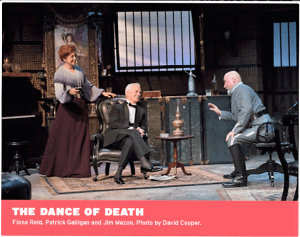
Tolstoy’s observation that “Happy families are all alike; every unhappy family is unhappy in its own way” is just as true for marriages as it is for families. In Strindberg’s The Dance of Death, the marriage of Edgar (Jim Mezon) and Alice (Fiona Reid) is a combination of “hate and love forged together in a foundry of Hell.” It’s the unhappiest marriage I have ever encountered, yet it makes for excellent theatre.Shaw-The Dance of Death 3.jpg

The play is an exploration of a search for meaning in life as much as it is a study of relationships. Alice and Edgar have become socially isolated from their military peers on an outpost island in Sweden. Edgar’s behavior is overbearing at best and tyrannical at worst; Alice’s is no better but managed in a shrewd, manipulative manner. Their antidote to arguing is to recall nasty encounters with other couples and to make denigrating comments. Let’s just say that Edgar and Alice would not make pleasant dinner companions. However, watching the give and take from the safety of the audience is fascinating.

Both Edgar and Alice struggle with what has brought them to this point in life. Their marriage of almost twenty-five years has been a “long miserable mistake”; Edgar’s fellow officers are eager to be rid of him; their children despise them.  Edgar, whose heart appears to be failing, notes, “I always believed we must be dead and paying some horrible penance.”  It’s a sad observation from someone who appears to have neither the skill nor the motivation to change, and it’s a sentiment Alice shares. She notes that, “If we can be patient, death will come.” It doesn’t come, but Alice’s cousin, Kurt (Patrick Galligan), does make an unexpected visit. For a short while his presence relieves the oscillating lassitude and hostility. It’s through the assorted interactions that we learn the backstory to the marriage—the many deceits, both innocent and treacherous, that have played out over a quarter of a century.

This review undoubtedly makes the play seem grim. It’s not that by any means. In many instances, it is quite funny. Edgar’s nearsightedness and his ‘spells’ are shy of slapstick, and points in the marital bickering are humorous, perhaps because they are familiar patterns even in healthy marriages.

The Dance of Death is well worth your time. It has been deftly directed by Martha Henry, and the actors are a strong ensemble. As I left the theatre, a song from my youthful explorations of existentialism came to mind—Is That All There Is?.  From this vantage point in life, my response is: ‘Yes, and….’

The Dance of Death is playing at The Shaw’s Studio Theater in Niagara-On-The Lake until September 10, 2016.

Bonnie Lendrum is the author of Autumn’s Grace, the story of how one family manages the experience of palliative care with hope and humor, despite sibling conflicts, generational pulls and career demands.

This Marlowe — A Mystery by a Master Storyteller

There are authors and books that make a powerful first impression. When that feeling is sustained through subsequent encounters in person and with their writing, then I know I’m in the presence of someone with a gift. Michelle Butler Hallett is such an author.

This MarloweI met Michelle in the early 2000’s at the Humber School for Writers in Toronto. We were both in Alistair MacLeod’s seminar group and we have each written about that honour. Michelle was a student whose commitment to form and language was articulate and impassioned, yet quietly and respectfully stated. I, who was secretly stumbling about on my keyboard, was in awe that anyone could find the words to speak about writing. Since that time, Michelle has produced five novels and several short stories. Writing is as natural for her as breathing.

Michelle’s most recent novel, This Marlowe, a work of historical fiction is set in the twilight of the reign of Queen Elizabeth I. It’s a tense spell-binding story of the last year of Christopher Marlowe’s life. Marlowe, the son of a cobbler, was also a graduate of Cambridge. The two facts, an unlikely combination for a poor boy, add fuel to the speculation that Marlowe may have been a spy for the Queen’s Secretary of State, Sir Robert Cecil. Marlowe’s violent death at the age of twenty-nine adds to the mystery and the rumors of espionage.

This Marlowe immerses the reader in the political machinations of an unstable time against the backdrop of Elizabethan England with all its beauty and grit. There were times when I felt like I could see, hear, smell, and touch the surroundings and experiences of Marlowe and his lover Thomas Kyd. The writing is taut, yet eloquent. Michelle has captured her characters, their language, phrasing and cadences in a way that is just shy of magic. She writes vividly about pain and suffering whether it comes from pneumonia, arthritis or torture.That same skill of offering the reader a virtual experience is equally present when she writes about love and compassion.

This Marlowe is one of the few books in my library I will be re-reading, as much for the pleasure of doing so as for the challenge of deciphering how Michelle Butler Hallett created this masterpiece.

Bonnie Lendrum is the author of Autumn’s Grace, the story of how one family manages the experience of palliative care with hope, humor, and knowledge, despite sibling conflicts, generational pulls and career demands.